OHSigns & road rules3 min readUpdated
Ohio school-bus stops: ten feet and the four-lane exception
Know when Ohio drivers must stop for a school bus, how four-lane and divided roads differ, and when to proceed.
By the US DMV editorial team · Passenger-car permit study
When an Ohio school bus stops to pick up or drop off passengers, first identify your direction of travel and the road layout. Ohio’s opposite-direction exception includes roads with four or more traffic lanes; it is not limited to roads with a concrete or grass median.
Compare the road layouts
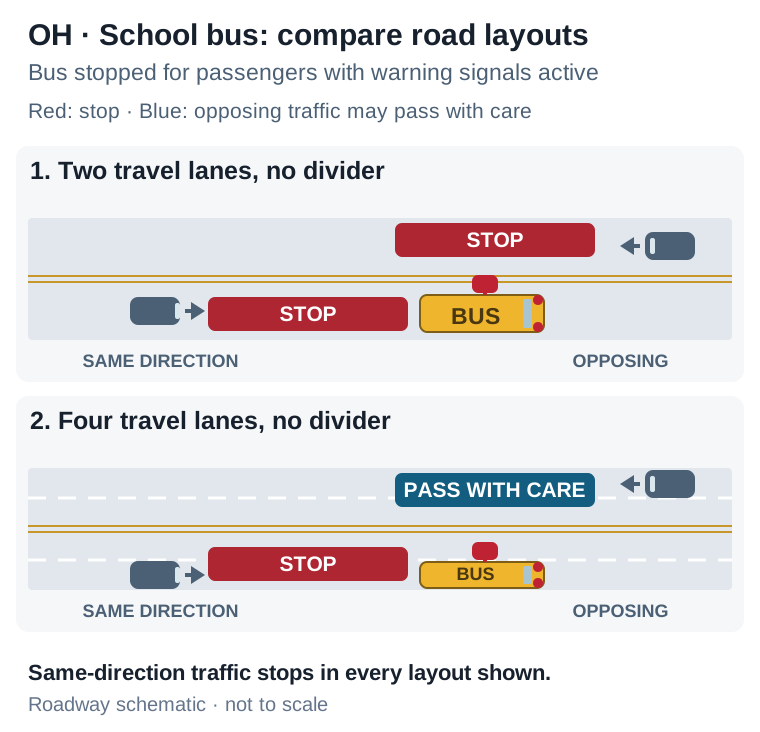
Open the diagram to enlarge it. Original roadway schematic based on the linked official rule. Read the full conditions below. §4511.75.
Stop at least ten feet away
Under section 4511.75, a driver meeting or overtaking a school bus stopped for loading or unloading must stop at least ten feet from its front or rear, subject to the opposite-direction exception. Stay stopped until the bus moves or the bus driver signals you to proceed.
Amber warning lights mean prepare to stop. Red flashing lights and the stop arm identify the loading stop, but do not treat an absent or malfunctioning stop arm as permission to pass: the statute expressly says failure to display the required stop sign is not a defense.
Match the scene to the rule
The Highway Patrol’s school-bus guidance explains the practical cases:
| Road and direction | Required response |
|---|---|
| Two-lane road, following the bus | Stop at least ten feet behind it |
| Two-lane road, approaching from the opposite direction | Stop at least ten feet in front of it |
| One lane each way plus a center turn lane | Both directions stop; the center lane does not create the four-lane exception |
| Four or more traffic lanes, traveling in the bus’s direction | Stop, including in a neighboring same-direction lane |
| Four or more traffic lanes, traveling in the opposite direction | You need not stop for the bus; proceed cautiously |
| Physically divided highway, bus on the opposite roadway | Patrol guidance allows opposing traffic to proceed cautiously |
For example, on an undivided road with two traffic lanes each way, the northbound bus stops. Northbound vehicles in both lanes must stop; southbound drivers may proceed cautiously. A physical median is not required for this four-lane exception.
A median is a separate layout consideration: Patrol guidance also describes the opposite-roadway exception for divided highways. A painted center line or center turning lane is not a physical separation. If you cannot identify the layout early, slow down and leave yourself space to assess it rather than making a last-second passing decision.
Wait for the correct release
A child reaching the sidewalk does not by itself authorize you to move. Wait for bus movement or the driver’s signal, then check that your path is clear. The bus driver separately must wait until discharged passengers reach safety on their residence side before starting. On divided or four-or-more-lane highways, buses must load and unload on that residence side.
Do not copy the car beside you or creep into the ten-foot space while waiting. Children may step around the front of the bus where you cannot see them. Keep watching even if you are in an opposing lane that is allowed to continue.
Build time into school routes
Expect repeated stops near school-opening and dismissal times. Keep a following distance that lets you see the bus lights and stop smoothly. A green traffic signal does not erase a school-bus stopping duty that applies to your lane and direction.
Read the Move Over guide for another situation where direction, available lanes and early observation determine the safe response.
Put what you learned into practice
OH Driver is coming soon. Use the state study resources and official handbook in the meantime.
State study resources