CASigns & road rules3 min readUpdated
California red lights and arrows: when can you turn?
Distinguish a circular red light, a red arrow, flashing red and flashing yellow in California.
By the US DMV editorial team · Passenger-car permit study
In California, a circular red light and a red arrow have different turning rules. A circular red can permit a right turn after a complete stop and yielding when no sign prohibits it. A red arrow prohibits the turn; wait for a green signal or arrow. Learn the signal shape before deciding what to do.
Three red-light right-turn situations
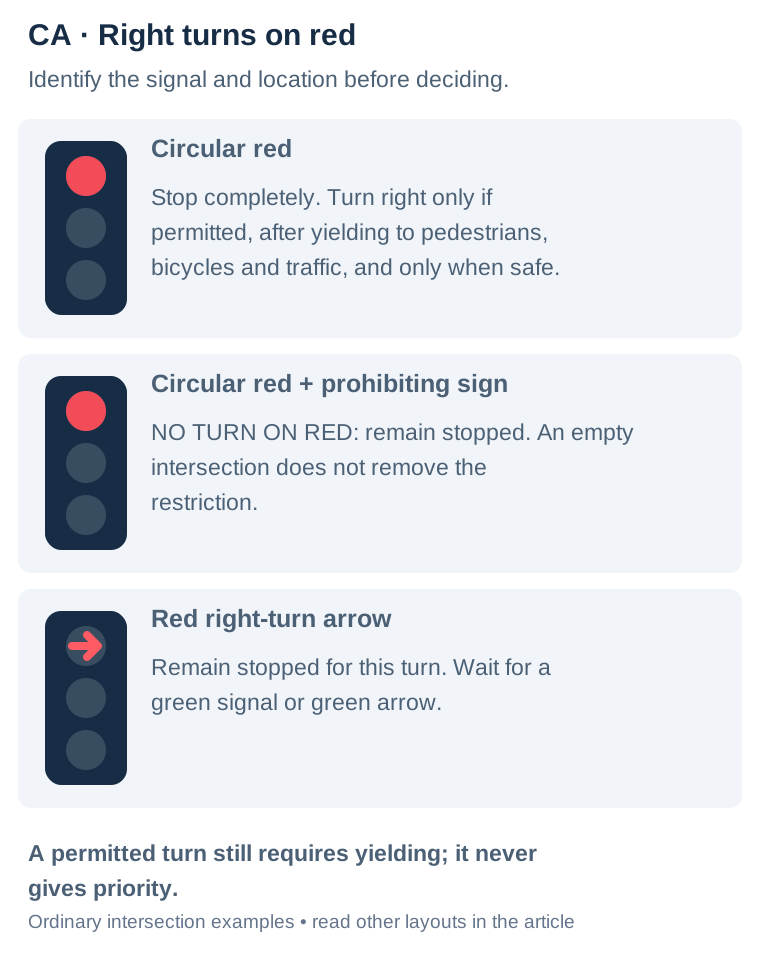
These are ordinary intersection right turns. Permission still requires stopping, checking prohibiting signs and yielding; the dedicated continuing-lane layout is explained below. Select the image to enlarge it. Original study diagram based on official guidance.
Compare four signals
| Signal | California handbook instruction |
|---|---|
| Solid circular red | Stop. A right turn is allowed only after stopping and yielding, with no NO TURN ON RED restriction. |
| Red arrow | Stop. Do not turn against the arrow; wait for green. |
| Flashing red | Stop, then proceed when safe under the applicable right-of-way rules. |
| Flashing yellow | Slow down and proceed with caution. |
A flashing yellow arrow is a separate signal: you may turn left after yielding to oncoming traffic and pedestrians. Do not treat it as a protected green arrow.
A complete stop is only the first check
For a permitted right turn on circular red, check the prohibiting signs, pedestrians, bicycles and other traffic. Stop behind the limit line. If there is none, stop before the crosswalk; if there is no crosswalk, stop before entering the intersection. Permission to turn does not give you priority over people crossing.
When the right turn continues into its own lane
The handbook describes a dedicated right-turn lane that continues into a lane of its own without merging. In that layout, you may turn without stopping even when the signal for straight-through traffic is red. Obey any signal or sign on the right curb of the turning lane and always yield to pedestrians in the crosswalk.
A right-turn arrow painted in an ordinary intersection lane does not by itself establish this layout.
Can you turn left on red?
After stopping, you may turn left on a circular red light from a one-way street onto a one-way street, provided no sign prohibits it. Yield to vehicles, pedestrians and bicyclists with the green light, look both ways and turn only when safe. A red arrow still prohibits turning.
Work through two contrasting situations
Circular red, no prohibiting sign, pedestrian crossing your path: the possible right turn does not remove the obligation to yield. Stay stopped while necessary for the pedestrian.
Red right-turn arrow, empty intersection: the lack of visible traffic does not change the red-arrow instruction. Wait for green.
Connect the signal to the rest of the junction
After identifying the light, look at lane markings and turn signs. A driver must still be in an appropriate lane and follow the restrictions for that movement. Read the intersection and lane-marking guide next.
Official sources
Reviewed October 30, 2026: California handbook: laws and rules of the road and navigating the roads.
CA Driver
Use CA Driver for practice in English, Spanish or Chinese, then review your mistakes. App questions are independent study material.