TXSigns & road rules3 min readUpdated
Texas school-bus stopping rules: the divider changes the answer
Learn when both directions stop, why a center turn lane is not a divided roadway, and when traffic may proceed around a Texas school bus.
By the US DMV editorial team · Passenger-car permit study
When a Texas school bus stops to load or unload students and displays its required red warning signals, approaching drivers normally must stop before reaching it from either direction. Being on the opposite side of a wide road does not, by itself, remove that duty. The key distinction is whether you are on a legally separate roadway.
The controlling rule is Texas Transportation Code §545.066. TxDOT’s school-bus safety guide gives a practical summary: watch for flashing red lights and the extended stop sign, and keep looking for children.
Painted lines, turn lane or physical divider?
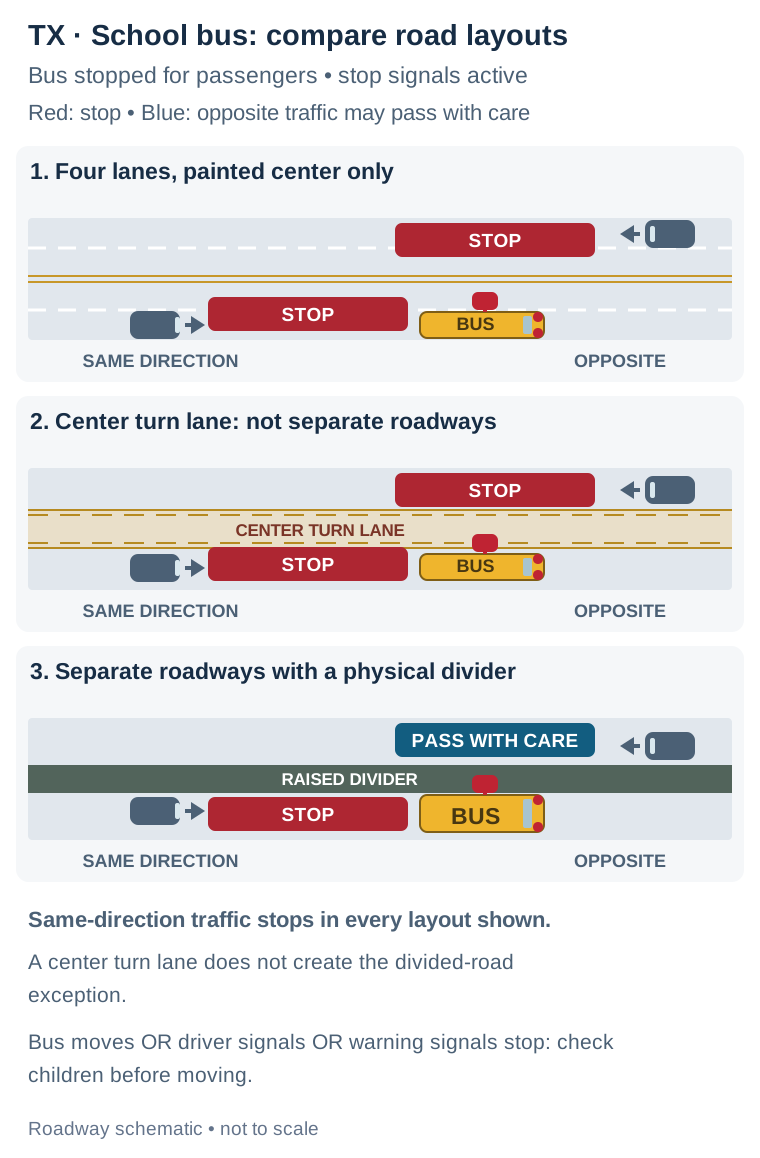
The bus is stopped with its lawful warning signals active. A center turn lane does not create separate roadways. Resume when the bus moves, its driver signals or warning signals cease, checking children first; the controlled-access loading-zone exception is explained below. Select the image to enlarge it. Original diagram based on current official rules.
Check the road, not just the number of lanes
| Road situation | What you must do when the bus stops with its warning signals |
|---|---|
| You are behind the bus on its roadway | Stop, including when another lane beside the bus appears open |
| You approach from the opposite direction on an undivided road | Stop |
| Opposing directions are separated only by a center left-turn lane | Stop; the law expressly says this does not create separate roadways |
| You are on the other roadway of a legally divided highway | The separate-roadway exception applies |
For this rule, separate roadways must be divided by an intervening space where driving is not permitted, a physical barrier, or a clearly indicated dividing section constructed to impede vehicles. Paint or a usable left-turn lane is not a substitute for that legal separation.
There is also a controlled-access-highway exception for a bus stopped in a loading zone that is part of or adjacent to the highway where pedestrians are not permitted to cross the roadway. Do not apply that exception to an ordinary curbside bus stop.
Three situations to rehearse
A bus faces you across a five-lane street with a middle turn lane. You must stop. Count the divider type, not the traffic lanes. The turn lane does not separate the roadways for this law.
A bus stops ahead in the right lane while you are in the left lane going the same way. Stop before the bus. An empty lane is not permission to go around children boarding or leaving it.
A bus is across a raised median on a different roadway. The separate-roadway exception can apply to your direction. Continue observing the area and obey any other signals or instructions; an exception does not make children or other road hazards disappear.
Wait for a legal release, then check for children
After stopping, §545.066 allows you to proceed when the bus resumes moving, the bus driver signals you to proceed, or the warning signal is no longer operating. These are alternatives; you do not need all three. Before moving, still check for children who may be crossing or hidden by the bus. Another driver’s movement is not one of the listed release conditions.
Keep enough following distance to see what the bus is doing and stop smoothly. When approaching a bus stop area, put away distractions and scan both sides of the road. For study, draw the road layout and identify the divider before deciding whether the opposite direction must stop.
Reviewed October 30, 2026. TX Driver is available on Google Play for practice in English, Spanish and Chinese; use the linked law for the precise exceptions.
TX Driver
Use TX Driver for practice in English, Spanish or Chinese, then review your mistakes. App questions are independent study material.